The UK will cross a ‘legal and ethical Rubicon’ if the law on assisted suicide in England and Wales is changed, the Archbishop of Canterbury has said. MPs will debate the Assisted Dying Private Members' Bill on Friday 11 September; it proposes to allow doctors to help terminally ill patients to die in some circumstances. Justin Welby said the bill would mean that suicide was ‘actively supported’ instead of being viewed as a tragedy. He and the heads of other Christian, Jewish, Muslim and Sikh groups believe the bill goes beyond merely legitimising suicide to actively supporting it and they have issued a joint letter urging MPs to reject it. The Archbishop said that asking doctors to aid suicide would be a change of monumental proportions both in the law and in the role of doctors. ‘This respect for the lives of others goes to the heart of both our criminal and human rights laws and ought not to be abandoned,’ the archbishop said.
Hundreds of Muslim refugees are converting to Christianity in a Berlin church. Pastor Gottfried Martens has seen his congregation at the evangelical Trinity Church grow from 150 to more than 600 in just two years, describing the number of conversions as a 'miracle.' One of these converts is Mohammed Ali Zonoobi, a carpenter from Shiraz, Iran, who was recently baptised. For Zonoobi and his wife Afsaneh their baptism marks a new beginning. Zonoobi is one of hundreds of mostly Iranian and Afghan asylum seekers who have been baptised at Trinity Church. However, there are concerns that some are not genuine converts, rather professing a Christian faith to boost their chances of staying in the country. Martens acknowledges this possibility, but says that, once in church, most people do engage and that around 90% of converts continue attending after they have been baptised.
Europe’s migrant crisis
10 Sep 2015
Europe is facing the world’s biggest refugee crisis since the second world war and it is being propelled by wars and persecution. Last autumn the EU suspended full-scale maritime rescue operations in the Mediterranean, believing that their presence was encouraging more migrants to risk the sea journey from Libya to Europe. However, people kept on coming (4% increase during the paused rescue missions). Millions of people are travelling to escape violence, poverty and conflict in their homeland. Their journeys have caused thousands of deaths. The European Commission has called for EU states to take in 40,000 migrants expected to arrive in Italy and Greece over the next two years. On Wednesday EU Commission President Jean-Claude Juncker proposed that 120,000 additional asylum seekers should be distributed among EU nations, with binding quotas. Several nations are anxious and undecided about resettling programmes for nationals seeking asylum and in need of international protection. See: http://www.bbc.co.uk/news/world-europe-34193568
Greece faces emergency
10 Sep 2015
Images of a small boy washed up on a Turkish shore flashed around the globe as a tragic representation of the current Mediterranean migrant crisis in which Greece is at the epicentre, with over 230,000 migrants surviving the treacherous journey to its shores in 2015. But Greece’s emergency goes far beyond this influx of migrants. Greece is racked with impossible debts, with no easy solutions. A legislative election will be held on Sunday 20 September, after which major decisions will need to be made. Greece stands at a crucial moment in its history. However, the greatest threat to Greece is not economic, political, or social. It is spiritual. Even though the evangelisation of Europe started here, less than 0.5% of Greeks are evangelical today. The Orthodox Church, though large, is often devoid of true life and faith. Greece stands today at the edge of a dangerous precipice.
BBC will broadcast in North Korea
10 Sep 2015
The BBC's decision to broadcast a daily news bulletin into North Korea has been welcomed by the World Watch Monitor (they report on Christians under pressure for their faith), who said it was the ‘best possible thing’ for people who wanted to see an improvement in North Korea. The BBC proposes ‘significant future investment in the World Service to areas with a democratic deficit in impartial news’. The broadcaster's director general said a daily radio news programme in North Korea was a key part of the plans and the organisation is going to ‘take risks, push boundaries’, and ‘not be afraid of controversy’. The executive editor of the World Watch List said that North Korea, of all the countries in the world, is probably one of the most restricted in terms of what they know about the outside world, because that view is almost entirely controlled by their government.
Healings and visions in the Arabian Peninsula
10 Sep 2015
One evening, Hammad went to bed as usual. However, he woke up feeling that someone was watching him. Thinking someone was in his room near his bed, he looked towards his window. There, in the window, he saw Jesus. Hammad looked at Jesus, and Jesus looked at him. He cannot tell you what he looked like: all he could remember were the eyes. The next day Hammad appeared at a Christian friend’s house and said, ‘I'm ready to make the decision,’ Although Hammad had already been convinced according to the Bible and the Qur'an, he couldn't quite make the decision to accept Jesus as his Lord and Saviour. When the Lord showed up, that convinced him. This is just one story of many where the Lord is revealing himself, not just in the Arabian Peninsula but across the nations where Muslims are searching for the Living God.
Week of Prayer for Refugee Crisis
07 Sep 2015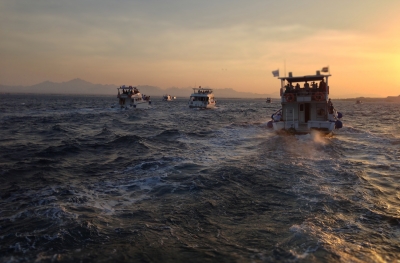
The Refugee Crisis: "We don't know the answer but we know we have to pray"
Brian Heasley - 3 Sep 2015
JOIN WITH US & OTHERS ALL OVER THE WORLD IN A WEEK OF PRAYER FOR THE REFUGEE CRISIS
This week 24-7 Prayer are asking you to sign up and pray in hour slots, wherever you are in the world, for the Mediterranean Refugee Crisis. The week will run from midday on Monday September 7th until midday on the 14th.
Join a global community longing for justice: sign up online, take an hour out your week and pray for those in need.
SIGN UP FOR A 1 HOUR PRAYER SLOT HERE
Praying into a crisis like this can feel overwhelming, the issues too innumerable to bring to God. But we cant let that paralyse us and we can't let it silence our prayers.
Instead, join with us - as we bring our humble, whispered, inarticulate words to God, trusting that he is listening.
And if we want to pray into specifics, lets get informed in how. If you want to learn more, you can read up on the crisis below - and below that, if you're looking for guidance in prayer, there's help with that too.
For more information visit the 24-7 Prayer website.
Prayer Request Card
07 Sep 2015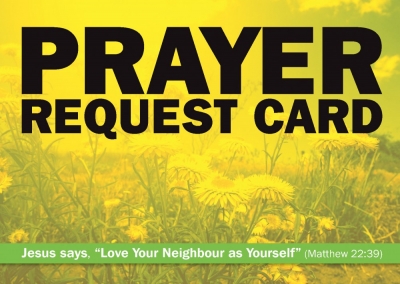
Neighbourhood Prayer Network have produced these simple card's that will help you reach out to your neighbours.
The card is designed to offer your neighbours the opportunity to submit a prayer request to your church, small group or House of Prayer.
We've got 100,000 to distribute, and this product is likely to be very popular, so please don't delay in your ordering.
Order them from the Neighbourhood Prayer Network website.